
-
Speedsurfingblog: Wind characteristics and surface
Why wind never is the same
Weather forecasts predict a near gale, force 7, gusts up to 40 Kts. Your day looks promising to break speedrecords easily. However on the water your enthousiasm dissipates. Wind is weaker than expected, gusts are strong, but shortlived and efficienty of the wind is a disaster. Reasons of this nightmare are not only in your mind, you can also measure it in the air. Characteristics of wind at the lowest 10 mtr are determined by:1. Surface roughness
2. Airmass stability
3. GustfactorIn this blog I will explain 1. surface roughness. In next blogs I will go on with airmass stability and gustfactor.
Ideal windprofile
In an ideal case surface roughness is zero. Wind isn’t deaccelerated. Thus windspeed is the same at all height (figure 1). Are there speedspots around where this exists? No, but spots with wind over mud (photo 1) come closest.

Disturbed winddprofiles
However earth surface is rough. Vegetation, sand and even flat water will force wind to slow down. Deacceleation is felt most in the lowest meters, the height where we go speedsurfing. Increasing surface roughness causes (Figure 2 and 3):– weaker winds
– larger vertical layer of weaker winds
– boundary with undisturbed wind above becomes higherPhoto 2 shows us Thomas Doeblin at his record day on 30rd July 2009. Strong SW’ly winds at speedspot Vollerwiek, together with an almost frictionless boundary gave a very strong and efficient wind in the lowest metrs (compare figure 2).
Photo 3 shows us a disturbed windprofile due to a low dam of rock at Herkingen (NL). Speedspot Herkingen is protected fairly good against building chop, but windfield is damaged significantly in the lowest meters due to the same chopkilling dam. Result is a relative weak, turbulent and inefficient wind in the lowest meters.


Wind observations
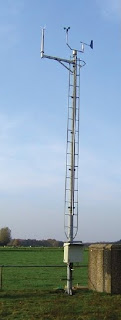
When we use wind observations from internet, we have to be aware that standard height of winddevices is at 10 mtr. Low enough to give relevant information about surface wind, heigh enough to neglect influence of small ellements like chop, trees (< 0,5 mtr) and rocks. However our sail is positioned between 0 and 4 mtr. We allready have seen that wind becomes weaker towards earth. 10 mtr observations can't be copied one to one into wind between 0 and 10 mtr! In a case with the same strength of 10 mtr wind, less wind is left for your sail in the case of rough surface compared to a surface with low roughness (Figure 4)
Windprofiles at sailing height
We choose 4 mtr as upper boundary to compare windprofiles because this is app. the top of our sail.
because this is height were WMO (World Meteorologic Organisation) has decided to meassure wind.[IMG]https://blogger.googleusercontent.com/tracker/3210168910980806269-3734542848651774343?l=www.speedsurfingblog.com[/IMG]
[IMG]http://feeds.feedburner.com/~ff/SpeedsurfingBlog?d=yIl2AUoC8zA[/IMG] [IMG]http://feeds.feedburner.com/~ff/SpeedsurfingBlog?d=63t7Ie-LG7Y[/IMG] [IMG]http://feeds.feedburner.com/~ff/SpeedsurfingBlog?i=co1kph4BjGs:dcudoBj90sg:F7zBnMyn0Lo[/IMG] [IMG]http://feeds.feedburner.com/~ff/SpeedsurfingBlog?i=co1kph4BjGs:dcudoBj90sg:V_sGLiPBpWU[/IMG] [IMG]http://feeds.feedburner.com/~ff/SpeedsurfingBlog?d=qj6IDK7rITs[/IMG] [IMG]http://feeds.feedburner.com/~ff/SpeedsurfingBlog?i=co1kph4BjGs:dcudoBj90sg:1ZLn2ZRv8yg[/IMG]
[IMG]http://feeds.feedburner.com/~r/SpeedsurfingBlog/~4/co1kph4BjGs[/IMG]


Tyvärr, inga svar hittades.
Logga in för att svara.